
DevDiary
How Kintinu has been built so far
A day-by-day diary of the build, newest first. Follow along as we build it.
16 November 2026
Route lines on the galaxy map, engine plumes in battle, and the first resource deposits to survey and mine.

In the build
Routes you can see
Give a fleet an order in Kintinu and its route now appears on the map, jump by jump along the hyperlanes, until the fleet arrives.
fleets, galaxy-map, movement
In the build
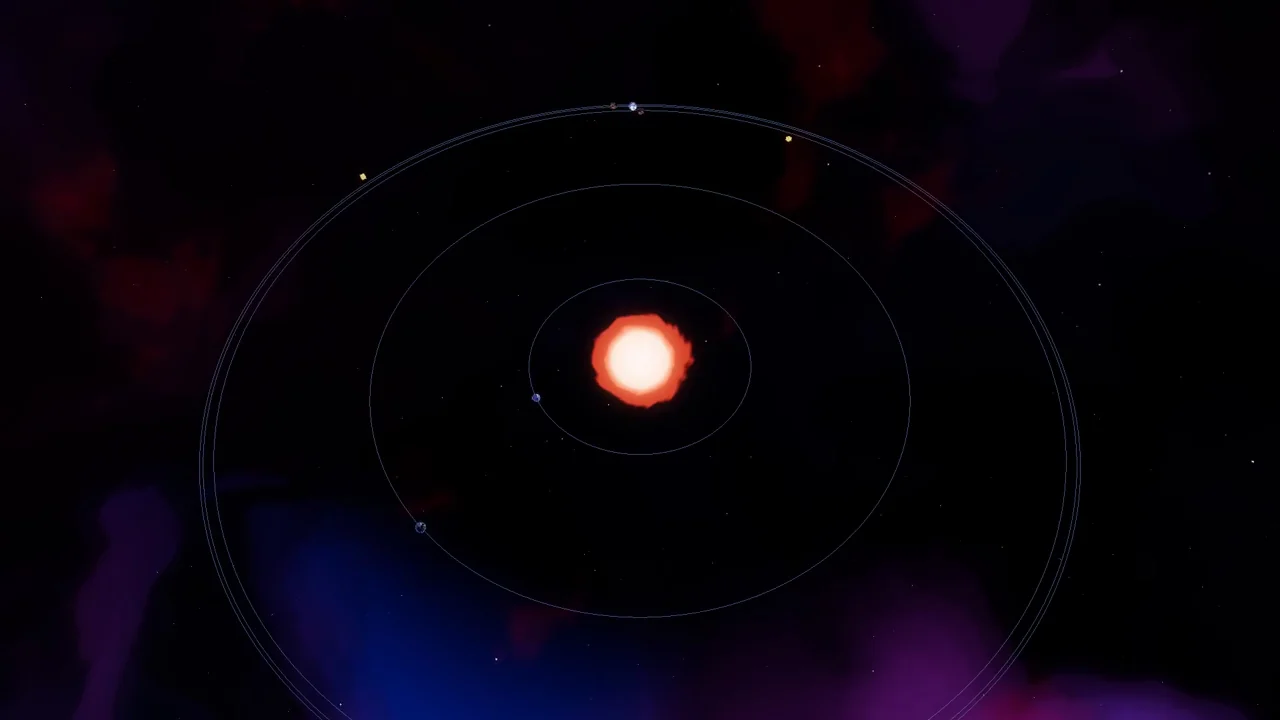
Flying into a star system
Every star on the Kintinu map is a place you can go. The camera flies from the hyperlanes around home straight into the home system.
system-view, galaxy-map, exploration
How it started
The side panel got thinner.
The side panel is now about a third narrower. Search sits behind a magnifier, filters open as a pop-up next to a filter symbol, and the panel is titled ASSETS.
Stars give light, and gas planets give gas.
We're spreading resources through the galaxy. Stars aren't mined, because they give sunlight and nothing else, and harnessing a star's power is left for the very late game. Gas planets hold gases that you can collect.
Prices now follow the stations.
The first piece of the living economy is in: a Markets tab where prices come from what each trading place has and needs. Next, traders, companies, cities and governments start buying and selling on their own. We want hundreds of independent traders.
The game got its name.
On the evening of 15 November the game became Kintinu, with the tagline Rule over the Stars. Kintinu means kingdom in Kikongo, and it can also mean kingship or royal rule.
Five ships now fly in the game.
The five ships of Kestrel & Vane Logistics are in the game: scout, escort, cruiser, battleship and freighter. The scout flies ahead and lets a fleet see further. Escorts take the front of the battle line, cruisers form the line and the battleship stays behind it. The freighter is a civilian ship that carries containers.
Technology pictures became flat schematics.
Our first technology pictures were rejected because their perspective was wrong. So we switched to flat engineering schematics in three colours, with a frame that has six levels. The first 45 schematics were approved that morning.
Kestrel & Vane joined the game.
On 14 November Kestrel & Vane Logistics became a faction you can play. By that afternoon its first long cruiser was accepted, and the plan for every other ship class was approved.
The look took shape.
On 13 November the interface found its direction: finely drawn frames with notched corners, HS LunaObscura for headings and Gyrochrome for text. That night we also questioned the ship style, and we began testing three ways to build ships.
We decided the game is a skeleton, on purpose.
On 12 November we said it plainly: all graphics and interface in the build are a working skeleton, to be changed later. That let us put rules, readability and speed first. We also chose the first faction to finish, Kestrel & Vane Logistics.
The first map landed.
In the early hours of 11 November the first galaxy map joined the game, with a simulation core underneath it. Entering a star system came next.
We chose real time and a huge galaxy.
Two early choices shaped everything. The game runs in real time with a pause button, and the galaxy is huge, about a thousand star systems, with single, pair or cluster layouts.
Two drafts became one game.
Kintinu began as two drafts of the same idea. On 10 November we decided they were one game with one concept, and we approved its direction that evening.
Pictures are added as the game takes shape.
Get the next entry in your inbox.
Sign up for the newsletter. We send only Kintinu news.